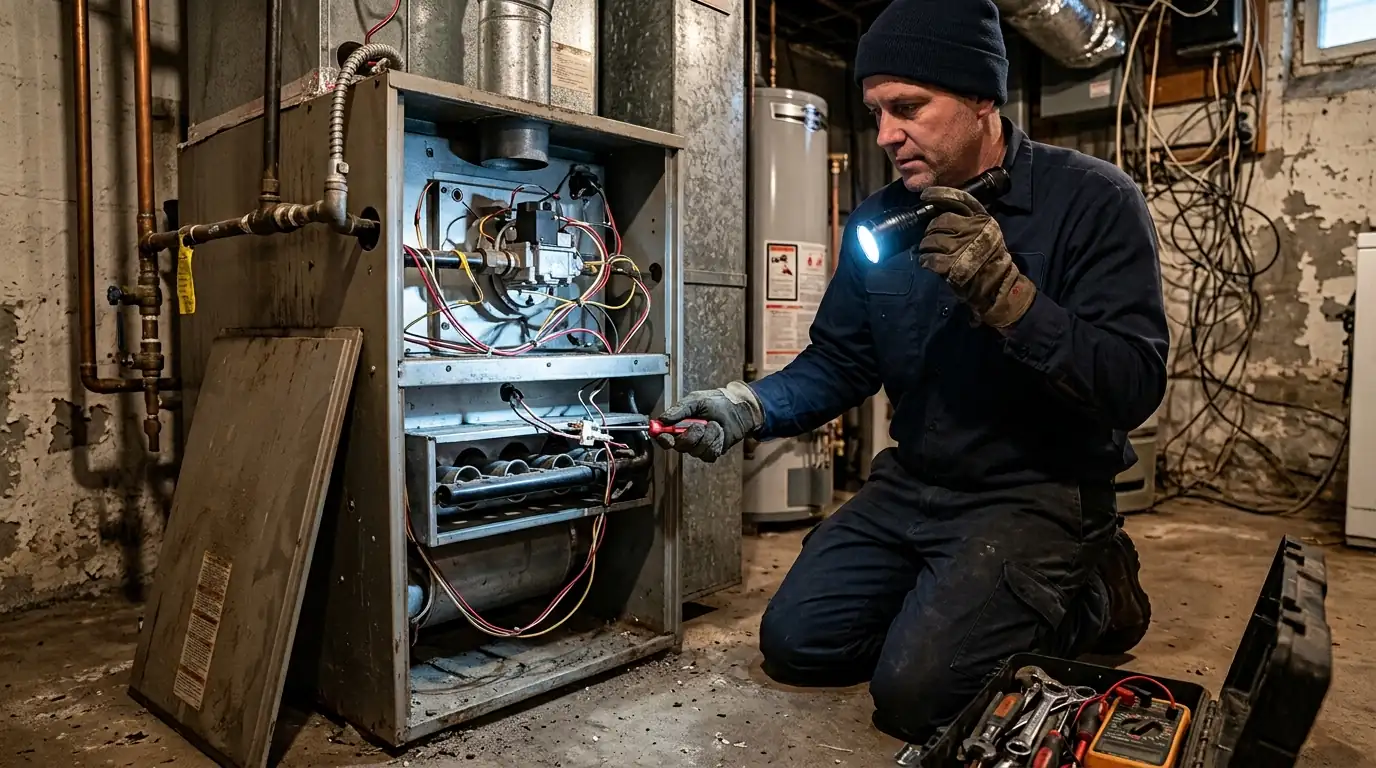
All common furnace brands
Furnace repair in Minneapolis, day or night
A furnace that quits in January is an emergency, and most of the time it is one part: an ignitor, a flame sensor, a pressure switch or a blower motor. We carry those parts, find the one that failed, and get the heat back on.
- 24/7 calls answered
- Minneapolis service office
- Ignitor to blower parts on the truck
- CO check every repair
Quick answer
Furnace repair in Minneapolis usually starts with a service call in the published 2026 range of $115 to $210, and most no-heat calls trace to one of four parts: a hot surface ignitor, a dirty flame sensor, a pressure switch or vent fault, or a failed blower motor. We check the heat exchanger and carbon monoxide on every visit.
Step by step
What happens on a no-heat call
- 1
Call any hour
Tell us the error light pattern, the furnace age and the indoor temperature.
- 2
Safety first
Gas, CO and venting are checked when we arrive.
- 3
Read the code and test
The fault code points to the part we test first.
- 4
Repair and cycle
The failed part is replaced and the furnace run through several cycles.
- 5
Report
You get the reading, the part replaced and anything else we saw.
Warning signs
Signs it is time to call
- Furnace runs but blows cold air
- Burners light then shut off after a few seconds
- Blinking light on the control board
- Squealing, grinding or banging when it starts
- Furnace short cycles on and off
- CO alarm sounds or soot around the burners
Heating
What usually stops a furnace
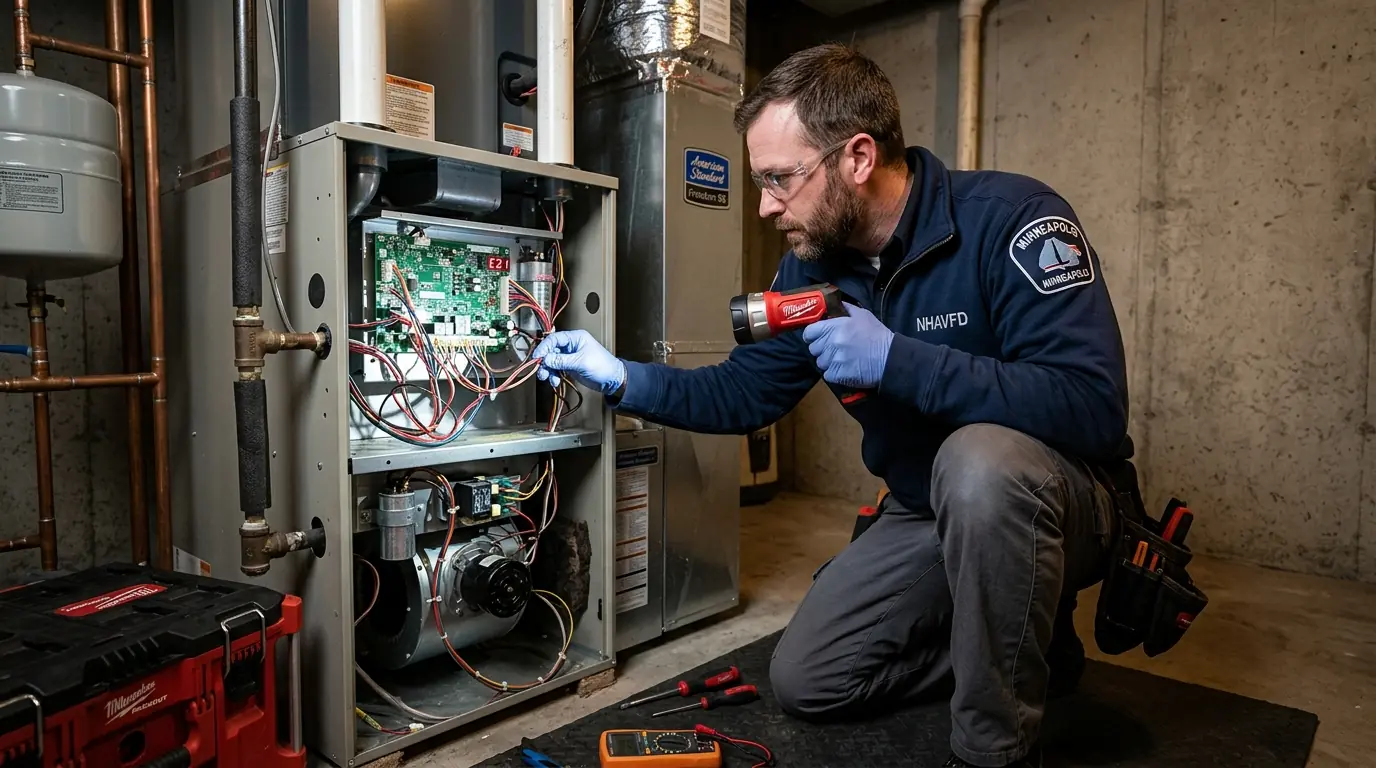
A modern furnace runs a strict sequence before it will fire: the thermostat calls, the inducer fan starts, a pressure switch proves the vent is clear, the ignitor glows, the gas valve opens, and the flame sensor confirms the burners lit. If any step fails, the control board stops and blinks a code.
We read that code, test the part it points to, and fix what failed. Then we check the heat exchanger, the flue and the carbon monoxide level, because a furnace that is running is not the same as a furnace that is safe.
Timing
How long until the heat is back
Ignitor, flame sensor, capacitor and pressure switch repairs are usually done within an hour or two, because those parts ride on the truck. A motor that has to be ordered takes longer; in a cold snap we set up temporary electric heat.
Ignitor and flame sensor faults
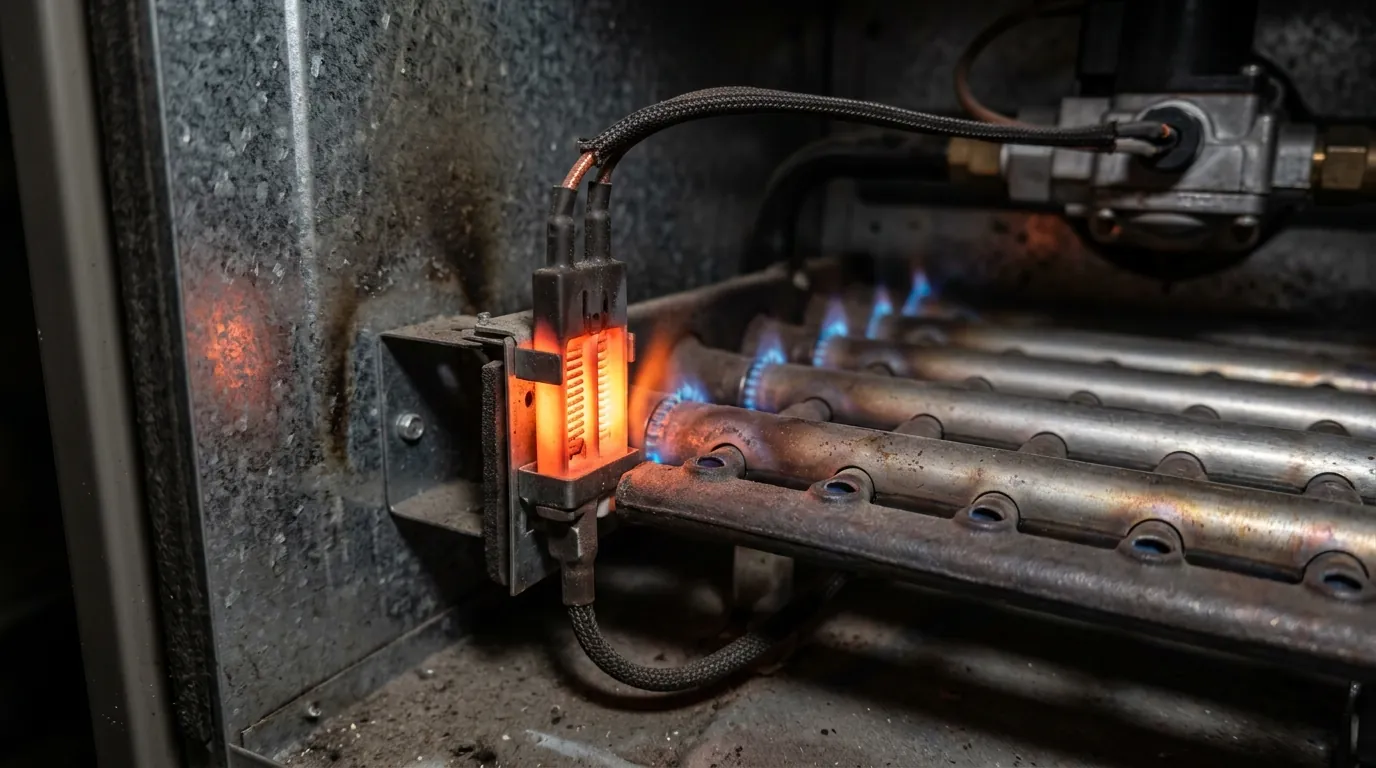
The two most common no-heat repairs are a cracked hot surface ignitor and a dirty flame sensor. A failed ignitor never glows, so the gas valve never opens. A coated flame sensor lets the burners light for a few seconds, then the board shuts them off because it cannot prove the flame, and the furnace retries three times before locking out. We test the ignitor's resistance, replace it if it is cracked or out of range, clean or replace the sensor, and watch several full cycles before calling it fixed.
Blower motor replacement
If the burners light but no warm air comes out of the registers, or the furnace shuts off on high temperature after a few minutes, the blower may not be running. Failed run capacitors, worn bearings and burned-out motors are the usual causes. We test the capacitor and the motor windings, check the blower wheel for the dirt that makes a motor overheat, and replace the capacitor or the motor with one matched to the furnace. Variable-speed ECM motors have their own module that sometimes fails separately.
Cracked heat exchanger
The heat exchanger keeps combustion gases separate from the air you breathe. When it cracks, usually from age and overheating, it can let carbon monoxide into the airflow. Signs include flame rollout, a flame that dances when the blower starts, soot, or a CO reading at the registers. We inspect with a camera and a combustion analyzer and show you what we find. A cracked heat exchanger is not a patch job; it usually means replacing the furnace, and we will shut the unit down if it is unsafe.
Pressure switch and vent faults
On high-efficiency furnaces the pressure switch confirms that the inducer is pulling exhaust out through the PVC vent. It opens when the vent or intake is blocked by snow or ice, when condensate backs up in the inducer or trap, or when the switch hose cracks. The furnace then shows a pressure switch code and will not light. We check the terminations outside, clear the trap and drain, test the switch and inducer, and fix the underlying cause so the next snowstorm does not shut you down again.
How Minneapolis homes shape this job
Minneapolis winters regularly reach 15 below, which is why the local HVAC market is shaped more by heating than cooling and why a failed furnace here is a real emergency. In Climate Zone 6A a furnace is sized large, often near 100,000 BTU for a 2,000 square foot house. When one has been oversized on top of that, it short cycles all winter, and the ignitors and flame sensors we replace on those units wear out years early.
Brands we service and install
The furnaces we repair and replace most are Carrier, Lennox, Trane, Bryant and Goodman, with Amana and Rheem close behind.
No heat tonight?
Call now. We answer 24 hours a day and dispatch from our Cahill Rd office with the common furnace parts on board.
Questions we get on the phone
Furnace repair questions from Minneapolis homeowners
Check the thermostat is on heat, the furnace switch is on, the filter is clean and the outside vent pipes are clear.
Most often a dirty flame sensor or a pressure switch fault. Both are common and quick to fix.
Not repeatedly. If it keeps locking out, something is failing, and it should be checked.
Yes, including Carrier, Lennox, Trane, Bryant, Goodman, Amana, Rheem and most others.
A cracked heat exchanger, age over 15 to 20 years with repeated repairs, or a repair nearing a third of replacement cost.
Cost factors
What moves the price
Published 2026 Minneapolis service-call rates run about $115 to $210. The repair itself depends on the part.
- The failed part. A flame sensor cleaning costs little; an inducer or blower motor costs more.
- Furnace type. High-efficiency furnaces have more components than older 80 percent units.
- Brand-specific parts. Some control boards and motors must be ordered.
- Time of the call. Night, weekend and holiday calls may cost more.
- Access. Attic and crawl space furnaces take longer to work on.
- Venting fixes. Rerouting or protecting a vent termination adds labor.
- Repair versus replace. On an old furnace with a cracked heat exchanger, replacement is the safe answer.
More from this category
Related work we handle
Furnace Installation
Two-Stage and Variable-Speed Furnaces and more.
About two-stage and variable-speed furnacesFrom our guides: What to check first when the heat goes out.
Get the heat back on
Call any hour. A technician will be dispatched with the common furnace parts on the truck.