Answering 24/7
Indoor air quality testing for Minneapolis homes
Stuffy rooms, musty basements, static shocks and dust that keeps coming back all have causes you can measure. We test humidity, carbon monoxide, carbon dioxide and particles room by room, then tell you which fixes would actually help and which would not.
- 24/7 calls answered
- Minneapolis service office
- Room by room readings in writing
- CO check every appliance
Quick answer
Indoor air quality testing in a Minneapolis home measures relative humidity, carbon dioxide, carbon monoxide near fuel-burning appliances and airborne particles, then ties the readings to the house's ventilation and HVAC. The result is a short list of fixes that match what was measured, such as humidity control, fresh-air ventilation or better filtration, instead of buying equipment on a hunch.
Air Quality & Ducts
Measure first, then decide what to buy
Air quality equipment is easy to oversell. A purifier will not fix a humidity problem, and a humidifier will not fix stale air. We start with readings: humidity and temperature in several rooms and the basement, carbon dioxide as a stand-in for how well the house is ventilated, carbon monoxide at the furnace, water heater and range, and particle counts with the system off and running.
Then we look at the house: duct leaks in dusty basements, bath and kitchen fans that exhaust nowhere, a filter slot that lets air bypass the filter, a crawlspace or sump pulling moisture into the house. You get the readings and a ranked list of fixes, smallest and cheapest first.
What is included
What an air quality test covers
- Humidity logged in living space and basement
- Carbon dioxide reading with the house occupied
- CO at each fuel-burning appliance
- Draft tested on atmospheric appliances
- Particle counts with blower off and on
- Filter slot checked for bypass
- Return ducts checked for leaks
- Bath, kitchen and dryer exhaust checked
- Written readings and ranked fixes
Humidity and moisture testing
Minneapolis houses swing from damp summers to very dry winters. We log relative humidity in living space and the basement, check for condensation on windows and cold walls, and look for moisture sources like a damp sump, an unvented dryer or a bath fan that dumps into the attic. The readings decide whether a dehumidifier, a humidifier, better exhaust or simply a fixed vent is the right next step. We also note readings near exterior walls and window frames, where winter condensation first shows up as staining or peeling paint.
Carbon monoxide and ventilation checks
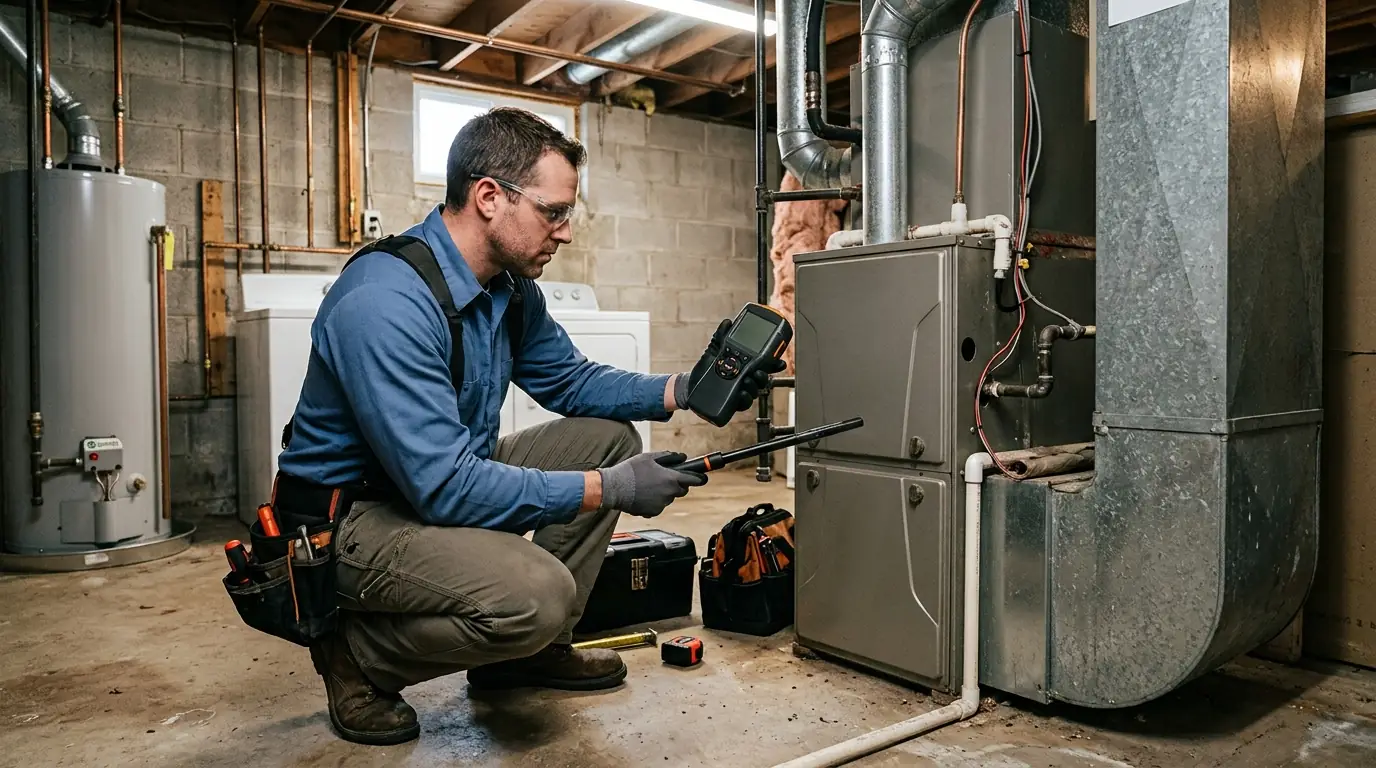
We measure carbon monoxide at every fuel-burning appliance and in the living space, and test draft on atmospheric water heaters and furnaces. Carbon dioxide readings with a few people home show how stale the air gets when the house is closed up for winter. High CO2 in a tight house points to fresh-air ventilation, often an HRV or ERV, rather than a purifier. We also check that the range hood and bath fans actually move air outside, since an exhaust fan that dumps into a cabinet or attic does nothing for the air you breathe.
Dust, particle and allergen testing
Particle counts taken with the blower off and on show whether the HVAC system is helping or spreading dust. We check the filter slot for bypass, the return ducts for leaks that pull basement or attic air in, and the filter rating the blower can actually handle. Sometimes sealing two return joints does more than any purifier. We also look at where dust settles first, near returns, on cold walls and around the furnace, since that pattern points to the leak or source. A properly sized pleated filter in a sealed slot often solves more than a standalone purifier would.
Local conditions that change the fix
Every air quality visit starts with carbon monoxide. Minnesota law requires a working alarm within ten feet of every room used for sleeping, so we check that yours are where they should be and tests CO at each fuel-burning appliance. Dry winter air is the other common complaint here, and it is why whole-home humidifiers are common in Minneapolis, but we measure first so a humidifier is only added where readings call for one.
Step by step
How an air quality test runs
- 1
Hear the complaint
Smells, dust, dryness, condensation or headaches.
- 2
Take readings
Humidity, CO2, CO and particles room by room.
- 3
Inspect the house
Ducts, filter slot, fans, sump and appliances checked.
- 4
Rank the fixes
Cheapest effective fixes first, with prices.
- 5
Retest if you fix
Readings repeated after work to confirm results.
Cost factors
What moves the price
Air quality testing is priced by the size of the house and how many tests are run. The fixes it recommends are priced separately, after you see the readings. Here is what moves the number.
- House size. More rooms and floors mean more readings.
- Tests chosen. Humidity, CO, CO2 and particles can be run together or separately.
- Combustion appliances. Each furnace, boiler or water heater gets its own CO and draft test.
- Duct inspection. Checking returns and filter bypass adds time.
- Moisture sources. Basements and crawlspaces add inspection points.
- Follow-up testing. A retest after fixes confirms they worked.
- Written report. Readings and ranked fixes are included.
Compare
What you can check yourself
| Homeowner | Our technician | |
|---|---|---|
| Window condensation in winter | Easy to spot | We measure humidity and find the source |
| A plug-in CO alarm | Good basic protection | We test each appliance's flue and draft |
| A cheap humidity gauge | Useful for trends | We log several rooms and the basement |
| Changing the filter | Worth doing often | We check that air is not bypassing it |
A humidity gauge and a CO alarm are worth owning. Testing tells you why the numbers look the way they do.
Questions we get on the phone
Indoor air quality testing questions from Minneapolis homeowners
Humidity, carbon dioxide, carbon monoxide at fuel-burning appliances and airborne particles, plus an inspection of ducts and ventilation.
Usually not. A musty smell points to moisture, which needs a source fix or dehumidification.
Cold outdoor air holds little moisture, and heating it makes the indoor relative humidity drop.
At typical home levels it signals stale air rather than a hazard, and points to better ventilation.
No. Many findings are small fixes like sealing ducts or repairing exhaust fans.
More from this category
Related work we handle
HRV and ERV Installation
Fresh Air for a Tight New Home and more.
About fresh air for a tight new homeWhole-Home Dehumidifier Installation
Ducted Dehumidifier Setup and more.
When you need whole-home dehumidifier installationFind out what is in your air
Call to book a test. You get the readings and a short list of fixes before anyone suggests equipment.