Answering 24/7
VRF systems and commercial heat pumps in Minneapolis
Variable refrigerant flow systems heat and cool many zones from one outdoor unit, each with its own control. For offices, clinics and retail with rooms that never agree on temperature, they solve what a single rooftop unit cannot.
- 24/7 calls answered
- Minneapolis service office
- Many zones one outdoor unit
- Cold-climate heat pump rated
Quick answer
A VRF system in a Minneapolis commercial building runs many indoor units from one outdoor heat pump, each zone with its own thermostat, and cold-climate models keep heating well below zero. It suits offices, clinics and retail with uneven loads; very cold nights may still call for backup heat, which we size into the design.
Commercial
Where VRF beats a rooftop unit
A packaged rooftop unit treats a building as one or two zones. That works for an open retail floor and fails in an office where the corner rooms bake in the afternoon while the interior conference room stays cold. VRF sends refrigerant to many small indoor units, each controlled separately, and the outdoor unit varies its output to match what the building actually needs.
The tradeoffs are design effort and refrigerant piping. VRF systems need careful load work per zone, refrigerant line routing that respects the manufacturer's limits, and a plan for fresh air, which VRF does not provide by itself. We lay those out with the numbers before you commit.
Compare
VRF against a packaged rooftop unit
| VRF | Packaged rooftop unit | |
|---|---|---|
| Zones | Many, each controlled | One or a few |
| Heating in deep cold | Capacity drops; backup planned in | Gas heat, steady output |
| Fresh air | Needs a separate ventilation unit | Built in |
| Upfront cost | Higher | Lower |
Cost factors
What moves the price
VRF and commercial heat pump projects are priced per building after a site survey. These are the main drivers.
- Number of zones. Each indoor unit and branch selector adds equipment and piping.
- Heat pump or heat recovery. Heat-recovery systems cost more but can heat and cool at once.
- Outdoor capacity. Sized to the building's peak heating load at design temperature.
- Backup heat. Electric strips or retained gas equipment for the coldest nights.
- Ventilation. VRF does not bring in fresh air; a dedicated ventilation unit may be needed.
- Ceiling and access. Open ceilings are faster than finished spaces.
- Controls. Central controllers and building integration vary widely.
VRF systems for offices and retail
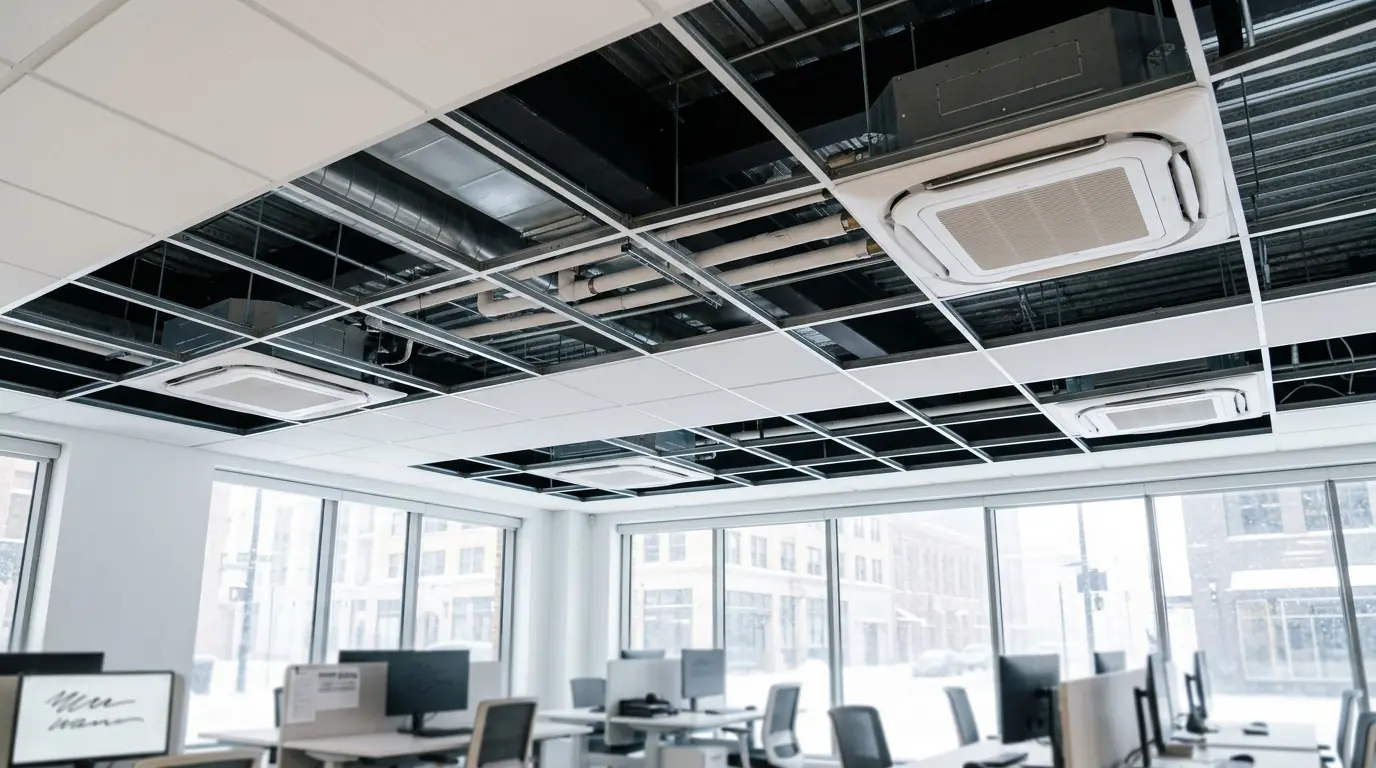
In offices and small retail spaces, VRF indoor units come as ceiling cassettes, concealed ducted units above a drop ceiling, or wall units in smaller rooms. Each room or group of rooms becomes a zone with its own control, and heat-recovery systems can cool one zone while heating another by moving heat between them. We size each indoor unit to its zone, choose the outdoor unit capacity against the building's peak load, and plan the refrigerant piping, branch selectors and condensate routes around the ceiling you have.
Cold-climate commercial heat pumps
Minnesota's winters are the real test for any commercial heat pump. Cold-climate VRF and packaged heat pump models keep producing heat far below freezing, but their capacity drops as the outdoor temperature falls, so the design has to cover the coldest design day. That may mean a larger outdoor unit, electric or gas backup heat, or keeping a small gas unit for the coldest nights. We show you the heating capacity at design temperature for the equipment we propose, not the rating at 47 degrees.
Adding zones to a VRF system
One of VRF's strengths is that zones can be added when a tenant space changes, as long as the outdoor unit has spare capacity and the piping design allows it. We check the existing system's capacity and connection ratio, add indoor units and branch piping, update the central controller, and recommission the system so the new zones are balanced with the old ones. If the outdoor unit is already at its limit, we will tell you before any ceiling tiles come down.
How Minneapolis homes shape this job
Cold-climate heat pumps are gaining ground in Minneapolis homes, where full installs run about $9,500 to $20,000 with utility rebates of $1,500 to $4,000, and many owners pair them with gas backup. Commercial buildings follow the same logic at a larger scale: the heat pump carries most of the season, and the design decides what covers the few nights when it cannot. We price VRF with and without backup so owners see both.
Step by step
How a VRF project runs
- 1
Survey and zone the building
Loads calculated per zone and existing equipment reviewed.
- 2
Design and quote
Indoor units, outdoor capacity, piping and backup heat chosen.
- 3
Rough-in
Refrigerant piping, branch selectors, drains and wiring installed.
- 4
Set equipment
Outdoor units lifted and set, indoor units hung and connected.
- 5
Commission
Pressure test, vacuum, charge, controls programmed and each zone tested.
Brands we service and install
Commercial equipment we service includes Carrier, Trane, Lennox and Daikin rooftop and split systems.
Questions we get on the phone
VRF and commercial heat pump systems questions from Minneapolis homeowners
Cold-climate VRF keeps heating well below zero at reduced capacity. The design includes backup for the coldest nights.
Often, with a separate ventilation unit for fresh air. We compare both options for your building.
Daikin, Mitsubishi Electric, Carrier and other major VRF lines.
Yes, if the outdoor unit has capacity. We check before any work starts.
It depends on the building; a small office is often a week or two of work, scheduled around your hours.
More from this category
Related work we handle
Commercial HVAC Installation
Split Systems for Small Commercial and more.
When you need commercial hvac installationCommercial HVAC Maintenance
Scheduled Service Visits and more.
When you need commercial hvac maintenanceZone your building properly
Call to set up a site survey, and we will price VRF alongside the equipment you have now.