Answering 24/7
Garage and shop heater repair in Minneapolis
A hanging gas unit heater keeps a Minneapolis garage or shop usable all winter, until it stops lighting on the coldest morning. Most failures are an igniter, a flame sensor, a pressure switch or a blocked vent, and we test the whole sequence before replacing parts.
- 24/7 calls answered
- Minneapolis service office
- Igniter to vent full sequence tested
- CO check every visit
Quick answer
A gas garage heater in Minneapolis is usually a ceiling-hung unit heater with an igniter, a flame sensor, an inducer fan and a pressure switch. When it will not light, lights and shuts off, or blows cold air, the cause is most often a dirty flame sensor, a failed igniter, a blocked vent or a bad pressure switch, all repairable in one visit.
Step by step
How a garage heater repair runs
- 1
Watch it try to start
Sequence observed from thermostat call to flame.
- 2
Find the failed step
Inducer, pressure switch, igniter, sensor or fan.
- 3
Check safety
Vent, heat exchanger and CO reading in the garage.
- 4
Repair
Part replaced or cleaned, vent cleared.
- 5
Run several cycles
Heater lights and stays lit each time.
Warning signs
Signs it is time to call
- The heater clicks or tries to light, then gives up.
- It lights, runs a few seconds and shuts off.
- The fan runs but blows cold air.
- A rumble, flame rollout or soot around the burner.
- Exhaust smell in the garage or a CO alarm.
- Ice, a nest or snow blocking the vent outside.
Heating
A small furnace that lives in a dusty, cold room
A garage unit heater works like a small furnace: the thermostat calls, the inducer fan starts, a pressure switch proves the vent is clear, the igniter lights the burner and a flame sensor confirms flame before the fan blows heat across the heat exchanger. Garages are dusty, damp and cold, so sensors foul, vents pick up nests and frost, and fans collect grime faster than a basement furnace does.
We follow the sequence step by step until it stops, which tells us exactly which part failed. We also check for carbon monoxide at the heater and in the room, because a garage heater with a cracked heat exchanger or blocked vent is a real hazard in a closed space.
Timing
How long the garage stays cold
Most garage heater repairs take one to two hours on a single visit, since sensors, igniters and pressure switches for common heaters ride on the truck.
Control boards and inducer motors for less common heaters may need ordering. If the heat exchanger is cracked we recommend replacement rather than a repair.
Igniter and flame sensor repairs
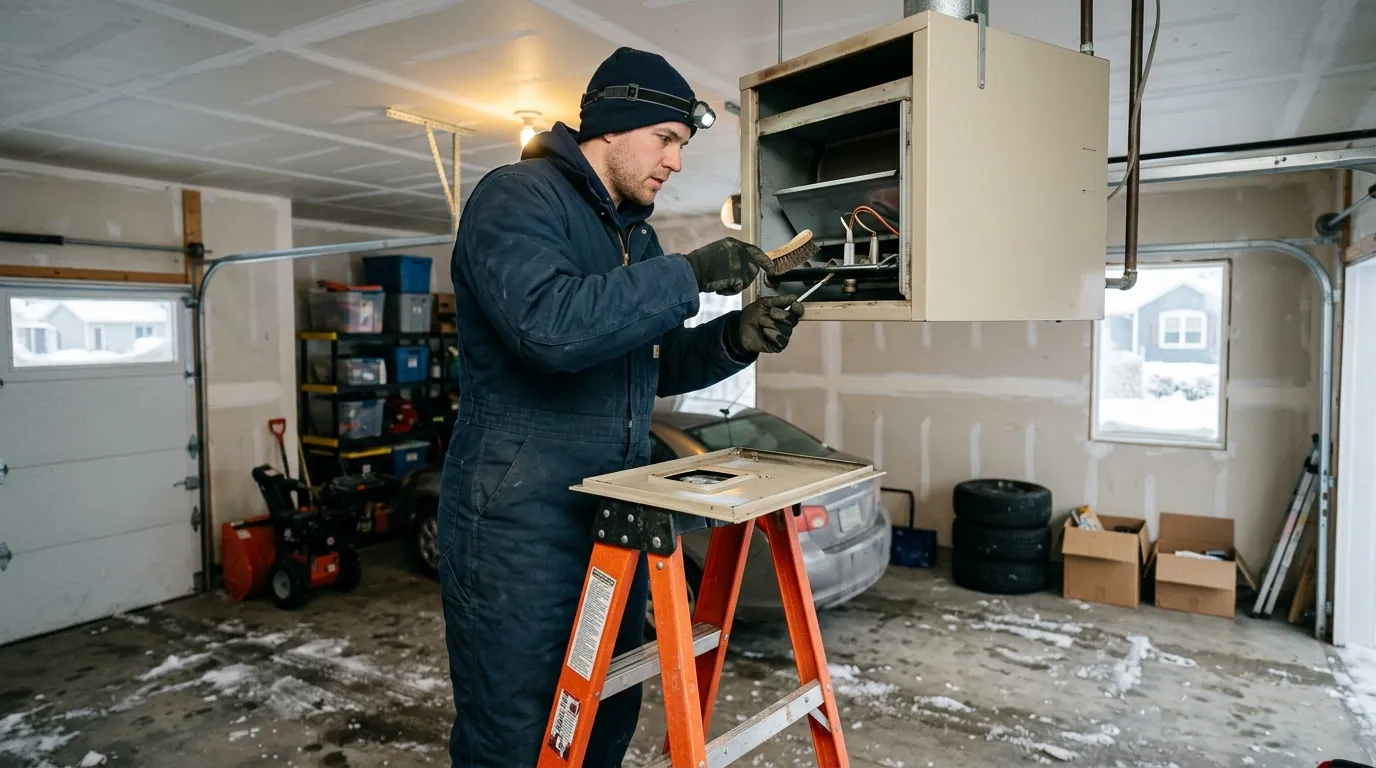
A heater that clicks, tries to light and gives up usually has a dirty flame sensor or a cracked hot surface igniter. Garage dust coats the sensor faster than in a house, so a cleaning often fixes it; a cracked or weak igniter gets replaced. Older standing-pilot heaters have thermocouples that fail the same way. We test the sensor signal after the repair so the heater stays lit through a full cycle, not just the first one. We also check gas pressure at the valve, since low pressure produces a weak flame that a clean sensor still cannot prove.
Venting and pressure switch problems
Side-wall and roof vents on garage heaters collect nests, frost and snow. When the vent is restricted, the pressure switch never closes and the heater will not light, which is the safety working as designed. We clear the vent, check the inducer fan and the pressure switch tubing, and confirm the vent run meets the heater's limits. A heater that runs with a partly blocked vent can push exhaust into the garage. On roof vents we check the cap and the pipe joints for frost buildup, and on side-wall vents we confirm the termination clears snow lines and nearby openings.
Fan, thermostat and heat exchanger checks
If the burner lights but the garage stays cold, the circulating fan, its motor or the thermostat is usually the problem. Garage thermostats get bumped, painted over and installed in drafty spots. We test the fan and motor, relocate or replace the thermostat when it reads wrong, and inspect the heat exchanger for cracks and rust, which garage condensation speeds up. On shop heaters we also check the fan blade for bent pitch and dust buildup, which cuts airflow and makes the high-limit trip. Where a heater is undersized for a larger shop, we explain that too, rather than replacing parts that are working.
How Minneapolis homes shape this job
Minnesota law requires a working carbon monoxide alarm within ten feet of every room used for sleeping, and an attached garage with a gas heater is one of the places CO can start. That is why every garage heater visit includes a CO reading in the garage and a look at the vent, not just a new igniter. A fall tune-up clears dusty sensors and blocked vents before the first hard freeze.
What is included
What a garage heater service call covers
- Full lighting sequence observed
- Inducer fan and pressure switch tested
- Igniter or pilot checked
- Flame sensor cleaned and tested
- Vent and termination cleared
- Heat exchanger inspected
- CO reading in the garage
- Fan, motor and thermostat checked
- Written findings before work
Questions we get on the phone
Garage heater repair questions from Minneapolis homeowners
A dirty flame sensor is the most common cause. The heater cannot confirm the flame, so it shuts the gas off for safety.
No. A blocked vent can push exhaust and carbon monoxide into the garage.
Once a year before winter, because garage dust and moisture foul sensors and vents faster than in a house.
Yes, including high shop ceilings where we bring a taller ladder or lift.
When the heat exchanger is cracked or rusted through, or the heater needs several major parts at once.
Cost factors
What moves the price
Garage heater repairs are priced after we find where the lighting sequence stops. A sensor cleaning is a small job; an inducer motor or heat exchanger is more. Here is what moves the number.
- Where the sequence fails. Sensor cleaning costs less than a new inducer or control board.
- Heater age. Parts for older heaters can be harder to source.
- Vent work. Clearing a nest is quick; rerouting a vent takes longer.
- Mounting height. High shop ceilings need a lift or taller ladder.
- Heat exchanger condition. A cracked exchanger usually means replacing the heater.
- Thermostat. Moving or replacing a misplaced thermostat adds a little time.
- Fuel type. Propane and natural gas heaters use different parts.
More from this category
Related work we handle
Garage heater out on a cold morning?
Call and tell us what the heater does when it tries to start. Most garage heater repairs are finished on the first visit.