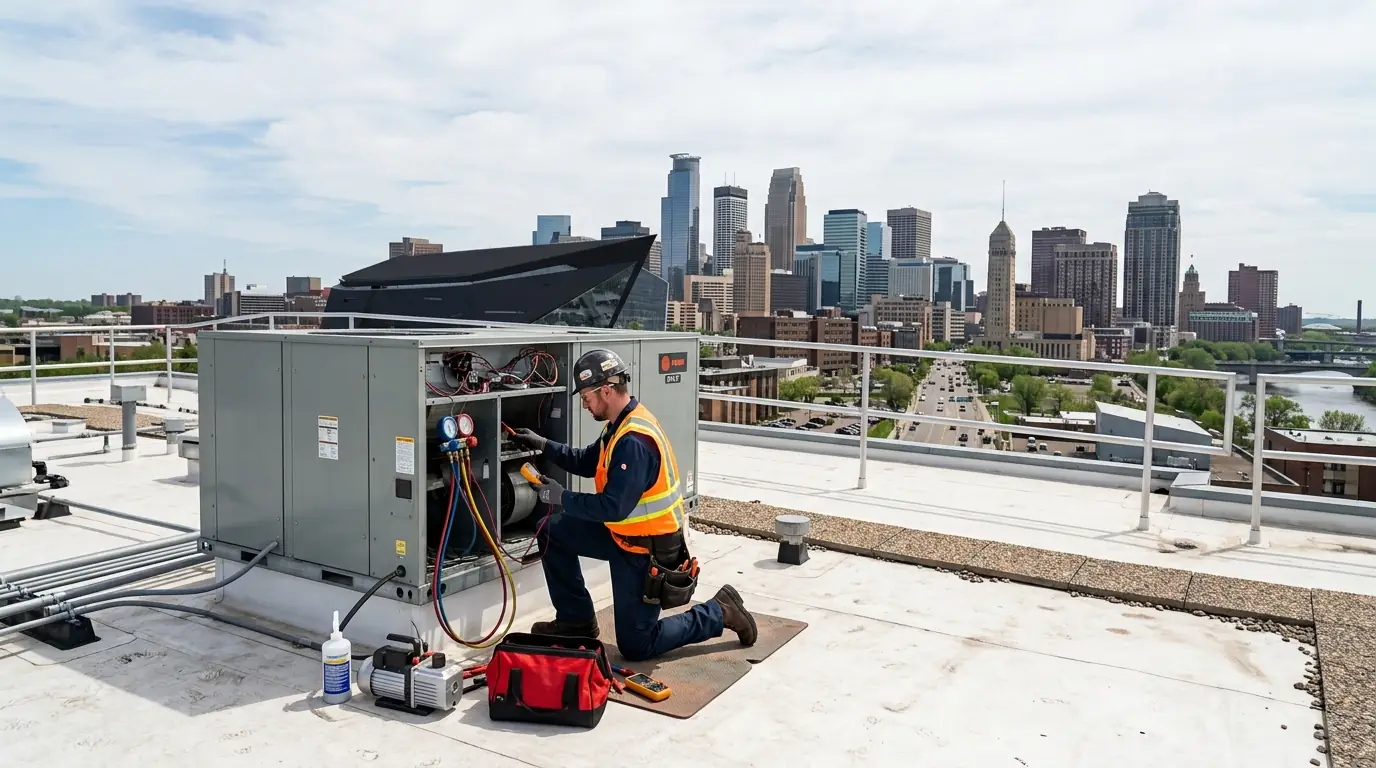
Answering 24/7
Commercial refrigeration repair in Minneapolis
A walk-in cooler or freezer that starts creeping warm puts a restaurant's inventory on a clock. We answer around the clock, find whether it is the condenser, the evaporator, the defrost or the box itself, and get the temperature back down.
- 24/7 calls answered
- Minneapolis service office
- Walk-ins coolers and freezers
- Night calls answered live
Quick answer
Commercial refrigeration repair in Minneapolis covers walk-in coolers and freezers, reach-ins and ice machines in restaurants, grocery and convenience stores. Most temperature losses trace to a dirty condenser, a failed fan motor, a defrost fault that ices the evaporator, a refrigerant leak or a door that no longer seals, and the first job is to find which.
Step by step
How a refrigeration service call runs
- 1
Hear the symptom
Box temperature, alarms and when it started.
- 2
Check the box
Door, gasket, heaters and evaporator ice inspected.
- 3
Test the system
Pressures, fans, defrost and condenser checked.
- 4
Repair or stabilize
Part replaced, or temporary cooling set while one ships.
- 5
Verify temperature
Box pulled down and holding before we leave.
Warning signs
Signs it is time to call
- The box temperature creeps up through the day and does not recover overnight.
- Thick ice on the evaporator coil or water pooling on the floor.
- The condensing unit runs nonstop or cycles rapidly.
- Frost or sweat around the door frame.
- The evaporator fans are silent when the door is closed.
- An ice machine making thin, slow or cloudy batches.
Commercial
Find whether it is the system or the box
A walk-in has two halves: the refrigeration system, with a condenser outside or on the roof and an evaporator inside the box, and the box itself, with its panels, door gasket, heaters and strip curtain. Product warms up when either half fails. A box with a torn gasket or a door that will not close can overwhelm a perfectly good system, while a healthy box warms fast when a condenser fan dies.
We start with temperatures, pressures and a look at the evaporator for ice, then work outward. If product is at risk, we tell you right away so you can move it, and we can often get partial cooling back while a part is ordered.
Timing
How long you are without refrigeration
Fan motors, defrost parts, gaskets and controls for common equipment are usually fixed on the first visit, often within a few hours of the call.
Compressors and major leak repairs can take longer while parts and refrigerant are sourced, and we can set temporary cooling to protect product in the meantime.
Walk-in cooler and freezer repair
Walk-in calls usually come down to an iced evaporator, a dead fan motor, a dirty condenser coil or low refrigerant. We clear ice safely, test fan motors and the defrost circuit, clean the condenser, and leak-check before adding refrigerant, since topping off a leaking system only buys a few days. Freezer boxes also get their door heaters and drain line heater checked, because a frozen drain line ices the floor and the evaporator. Before we leave, we watch the box pull down and confirm the defrost cycle starts and ends on schedule.
Reach-in cooler and ice machine service
Reach-in coolers and prep tables fail on small parts: condenser fans, thermostats, gaskets and dirty coils under the cabinet where kitchen grease collects. Ice machines lose production when their condenser is dirty, their water filter is spent or scale builds on the evaporator plate. We clean, descale and test these units and replace the failed part, and we can put them on a cleaning schedule so they stop failing at lunch rush. We also check door gaskets and hinges on reach-ins, since a door that drifts open overnight wastes a full shift of cooling.
Defrost, door seal and box repairs
A box that ices up, sweats around the door or never quite reaches temperature often has a box problem. We test defrost timers and heaters, replace torn door gaskets and failed door closers, check the door frame heater on freezers, and look for gaps in panels and strip curtains. These repairs are usually cheaper than system work and stop the system from running nonstop. We also check that the floor and threshold are not icing or heaving, since a door that drags on ice never closes fully. A box that is holding temperature again after these repairs also puts less wear on the compressor and fans.
What we see on calls around Minneapolis
The Minnesota Food Code requires cold food to be held at 41F or below, and food that sits above 41F for four hours or more has to be thrown out. That four-hour clock is why a walk-in creeping warm is an emergency for a Minneapolis kitchen, and why our first question on the phone is the current box temperature and how long it has been climbing.
What is included
What a refrigeration service call covers
- Box and product temperatures logged
- Evaporator checked for ice
- Evaporator and condenser fans tested
- Defrost timer and heaters tested
- Refrigerant pressures read
- Condenser coil cleaned
- Door gasket and closer inspected
- Drain line and heater checked
- Written findings before work
Questions we get on the phone
Commercial refrigeration repair questions from Minneapolis homeowners
Move the most temperature-sensitive items to working refrigeration and keep the door closed while you wait for us.
A defrost fault, a failed fan, a bad door seal or low refrigerant are the common causes.
Yes. We clean, descale and repair ice machines and can schedule regular cleanings.
Yes. Calls are answered around the clock and refrigeration failures are dispatched as urgent.
Condenser coils should be cleaned several times a year in a busy kitchen, with a full check at least yearly.
Cost factors
What moves the price
Refrigeration repairs are priced after diagnosis. Fans, gaskets and controls are smaller repairs; compressors and major leaks are larger. Here is what moves the number.
- Part that failed. Fan motors, gaskets and controls cost less than compressors.
- Refrigerant work. Leak search, repair and recharge add time and material.
- Equipment age. Parts for older condensing units may need ordering.
- Box condition. Panel, door and heater repairs add to the visit.
- Location of the condenser. Rooftop condensers need roof access.
- After-hours timing. Night and weekend calls cost more than scheduled visits.
- Product at risk. Temporary cooling while a part ships adds a visit.
More from this category
Related work we handle
Walk-in losing temperature?
Call now. We will help you protect product while a technician is on the way.