Answering 24/7
Garage heaters installed in Minneapolis
A heated garage turns a Minnesota winter into a season you can still work through: a shop that stays usable, a car that starts, a slab that sheds snow. We size the heater to the space, run the gas line, vent it properly and mount it where it heats without getting in the way.
- 24/7 calls answered
- Minneapolis service office
- Gas line run and tested
- Sized to the space bTU calculated
Quick answer
Garage heater installation in Minneapolis usually means a ceiling-hung gas unit heater or an infrared tube heater, sized to the garage's volume and insulation, with a gas line, a vent, and clearance from vehicles and storage. HVAC permit fees in Minneapolis run $84.20 to $216.60 depending on the job.
Heating
Picking the right heater for the garage
The right heater depends on how you use the space. A garage that only needs to stay above freezing for parked cars needs far less than a workshop kept at 60 degrees, and an insulated attached garage needs much less than a drafty detached one.
We measure the space, check insulation and door seals, and ask how you plan to use it before sizing the heater. Then we pick the type, plan the gas line and vent route, and mount it at the right height and clearance.
Compare
Unit heater or infrared
| Gas unit heater | Infrared tube heater | |
|---|---|---|
| How it heats | Warms the air with a fan | Warms surfaces and people |
| Best for | Attached garages, standard ceilings | Tall ceilings, frequent door opening |
| Recovery after door opens | Moderate | Fast |
| Upfront cost | Lower | Higher |
Cost factors
What moves the price
Garage heater projects are priced by the heater, the gas line and the venting.
- Heater type and size. Unit heaters cost less than infrared tube heaters of similar output.
- Gas line length. Detached garages need longer, often underground, lines.
- Venting. Wall venting is simpler than roof penetrations.
- Electrical. A circuit may be needed for the heater's fan and controls.
- Mounting. Tall ceilings and tube layouts take more hardware.
- Insulation. An uninsulated garage needs a larger heater.
- Permit. Minneapolis HVAC permits run $84.20 to $216.60.
Gas unit heaters
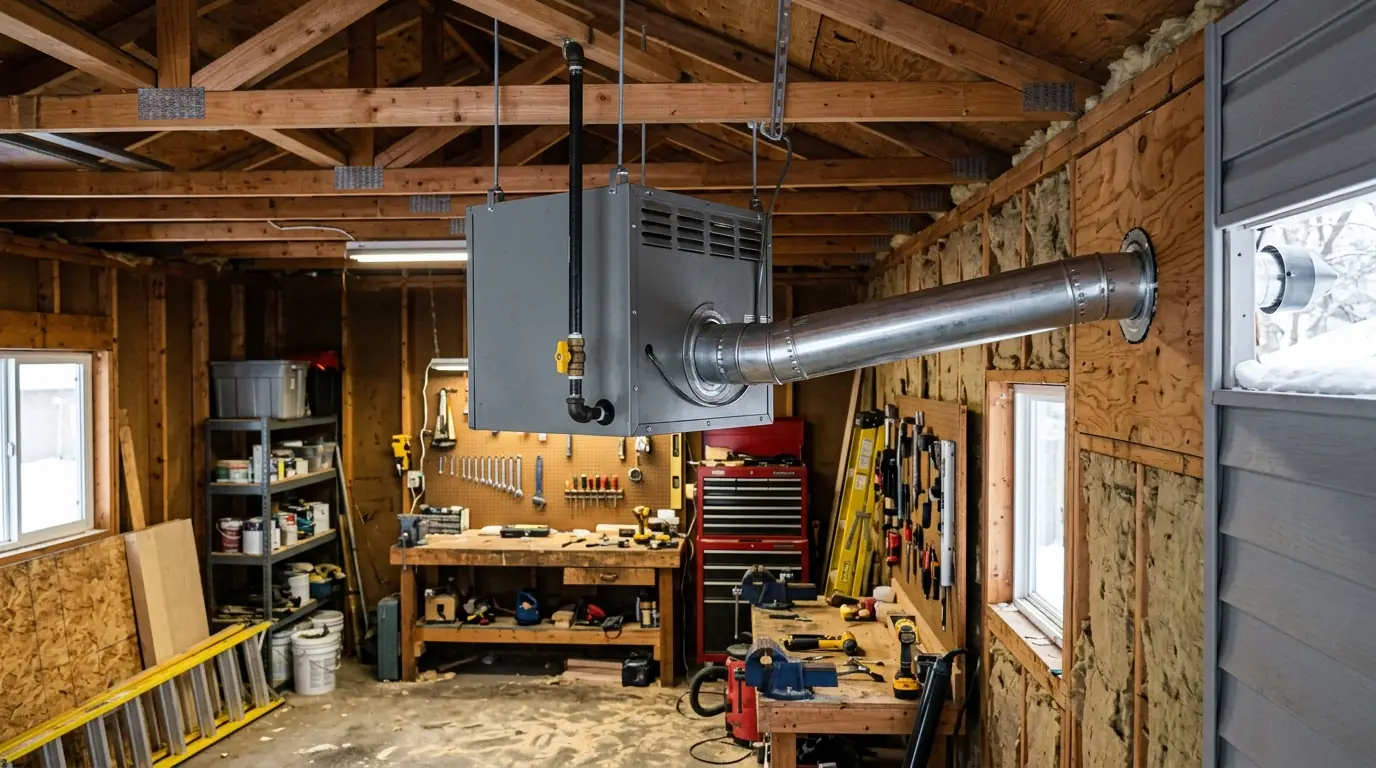
A gas unit heater hangs from the ceiling and blows warm air across the garage with a fan. It is the most common choice for attached garages and shops: it heats the air quickly, is affordable to buy, and fits most spaces. We size it to the garage's volume and insulation, hang it high enough to clear a vehicle or garage door track, aim the airflow along the length of the space, and vent it through the wall or roof. A separated-combustion model is used where dust or fumes are a concern.
Infrared tube heaters
Infrared tube heaters warm surfaces and people rather than the air, much like the sun. That makes them well suited to garages with tall ceilings, frequent door openings or a workbench where you want warmth right where you stand. The floor and the car absorb the heat and release it back, so the space recovers quickly after the door closes. Tube heaters need more mounting length and clearance from stored items, and we lay out the tube so it does not sit over anything flammable.
Gas line and venting for a detached garage
A detached garage usually needs a new gas line from the house, often run underground in approved yellow polyethylene pipe with a riser at each end, or overhead where that is allowed. We size the line for the heater and any future appliances, pressure test it, and install a shutoff at the heater. Venting goes through the wall or roof with the right clearances from doors and windows. If the garage has no power, the heater's fan and controls need a circuit, which we coordinate with an electrician.
How Minneapolis homes shape this job
HVAC permit fees in Minneapolis run from $84.20 to $216.60 depending on the job, and a new garage heater with its own gas line and vent falls under that permit process. We pull the permit before work starts and schedule the inspection, which matters for insurance and for resale when a buyer's inspector asks about the heater and whether the gas line was tested.
Step by step
How a garage heater install runs
- 1
Measure and size
Garage volume, insulation and use set the BTU size.
- 2
Pick the type
Unit heater or infrared tube chosen with you.
- 3
Run the gas line
Line sized, installed and pressure tested.
- 4
Mount and vent
Heater hung with clearances, vented to the outside.
- 5
Wire, start and test
Thermostat connected, heater fired and checked.
Brands we service and install
The furnaces we repair and replace most are Carrier, Lennox, Trane, Bryant and Goodman, with Amana and Rheem close behind.
Questions we get on the phone
Garage heater installation questions from Minneapolis homeowners
It depends on the garage's volume, insulation and the temperature you want. We calculate it on site.
Yes, with a gas line run from the house or an electric heater if gas is impractical.
Gas heaters with new lines and venting require a permit, which we pull.
Yes, with a properly vented heater mounted at the correct height and clearances.
Unvented heaters add moisture and combustion gases to the space. A vented heater is the safe choice.
More from this category
Related work we handle
Radiant Floor Heating
In-Floor Heat for a Basement Finish and more.
About in-floor heat for a basement finishFurnace Installation
Two-Stage and Variable-Speed Furnaces and more.
Furnace and AC Combined ReplacementWork in the garage all winter
Call to have the space measured and a garage heater sized and quoted.