Answering 24/7
Fan coil unit repair for Minneapolis condos and apartments
Most Minneapolis condo towers heat and cool each unit with a fan coil hidden in a closet or soffit. When it stops blowing, drips on the floor or starts rattling, the fix is usually a motor, a valve or a clogged drain, and we carry those to the door.
- 24/7 calls answered
- Minneapolis service office
- Motor to valve parts on the truck
- Drain check every visit
Quick answer
A fan coil unit in a Minneapolis condo is the small blower and coil that heats and cools one apartment, fed by hot and chilled water or refrigerant from the building. Most failures are a worn blower motor, a stuck control valve, a clogged condensate drain or a dirty coil, and each can usually be repaired in one visit without touching the building system.
Step by step
How a fan coil repair runs
- 1
Ask what the building supplies
Heating or cooling season, and any riser work underway.
- 2
Test the unit
Motor, capacitor, valve, actuator, thermostat and drain checked.
- 3
Explain and price
What failed and what it costs, before work starts.
- 4
Repair
Part replaced, drain cleared, coil cleaned where needed.
- 5
Run it in both modes
Airflow, temperature split and drain checked before we leave.
Warning signs
Signs it is time to call
- The fan runs but the air is room temperature in both heating and cooling season.
- Water on the closet floor, a stained ceiling below, or a musty smell from the unit.
- A hum with no airflow, or a breaker that trips when the fan starts.
- Rattling, scraping or squealing from the cabinet when the blower runs.
- Only one speed works, or the fan never shuts off at the thermostat.
- Your unit stays warm in July after the building switched to cooling.
Cooling
What a fan coil does, and why it quits
A fan coil is a cabinet with a blower, a coil and a control valve. In hydronic buildings the coil carries hot water in winter and chilled water in summer from the central plant; in others it is a refrigerant coil tied to a condenser. Either way, the unit in your closet only moves air across that coil and drains the water it pulls from the air.
That makes the common failures predictable. Motors wear out after years of running nearly nonstop, valves stick open or closed, drain pans and lines clog with sludge and overflow, and coils load up with dust when filters are skipped.
Timing
How long you are without heat or cooling
Most fan coil repairs finish in one visit of one to three hours; common motors, capacitors and actuators ride on the truck.
A valve body that needs the riser drained, or a motor for an older proprietary cabinet, can take a second visit once building staff schedule the shutoff or the part arrives.
Fan coil blower motor replacement
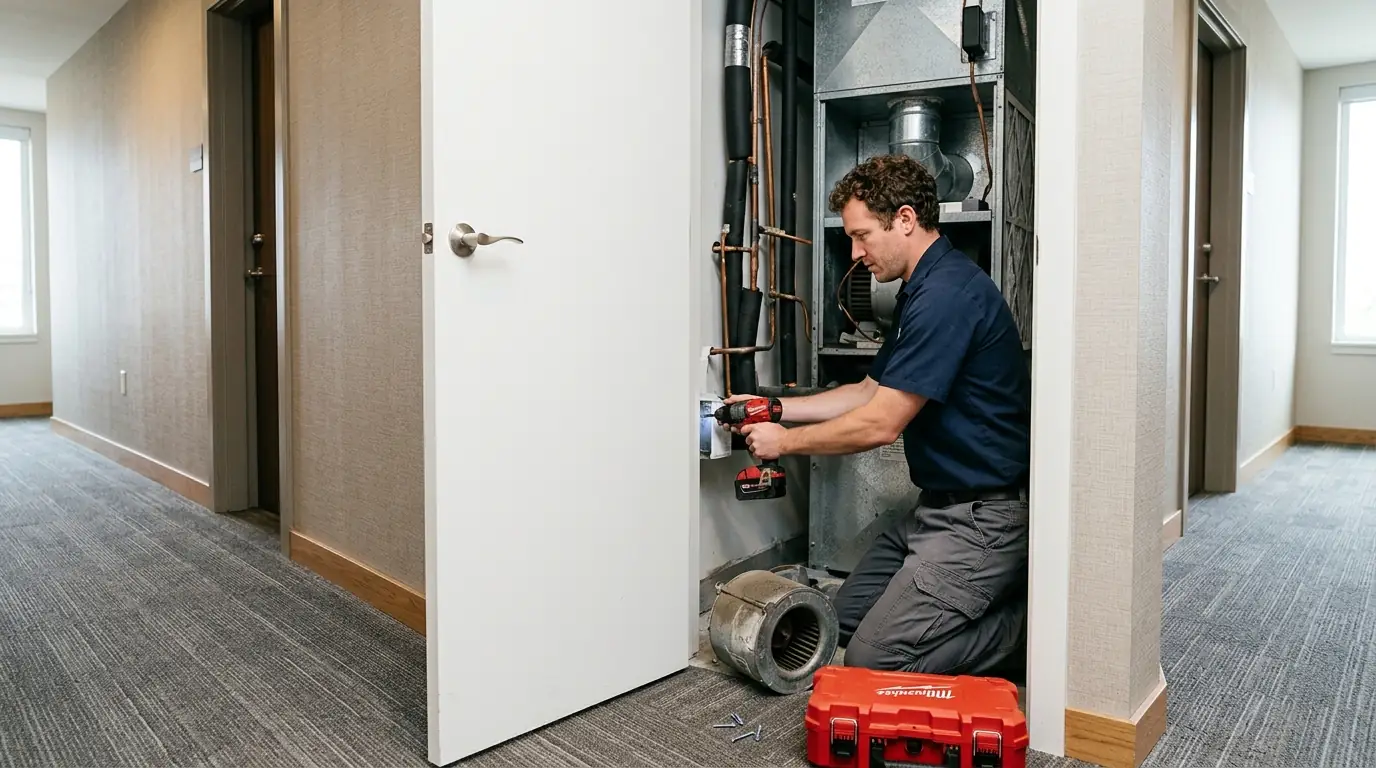
A fan coil that hums but does not blow, blows weakly, or trips its breaker usually has a failing motor or capacitor. We test the motor windings and capacitor, check the blower wheel for dirt and balance, and replace the motor with one matched to the unit's speed taps. Many condo fan coils use multi-speed motors wired to a wall thermostat, so we confirm each speed works before we leave and that the new motor does not overload the circuit.
Control valve and thermostat faults
When the fan runs but the air never gets warm or cool, the control valve or its actuator is the usual suspect. Two-pipe buildings switch the whole riser between heating and cooling seasons, so we first confirm what the building is supplying, then test the actuator, the valve body and the thermostat signal. A stuck valve can often be freed or its actuator replaced without draining the riser; when a valve body has to come out, we schedule the isolation with building staff.
Condensate drain and coil cleaning
Water on the closet floor or a musty smell means the drain pan or line is backing up. We clear the line, flush and treat the pan, check the pan for rust-through, and confirm the unit is level so water runs to the drain. A matted coil gets cleaned so air passes freely again, which also cuts the condensation that feeds sludge. A float switch that shuts the fan off before an overflow is a cheap addition we can fit on the same visit.
What we see on calls around Minneapolis
About 53 percent of Minneapolis housing units are renter-occupied, roughly 89,000 units, and many sit in buildings where every apartment heats and cools through its own fan coil. That split matters on a service call: the unit in your closet is often the owner's or tenant's responsibility while the risers belong to the building, so we confirm who to talk to before any shutoff is scheduled.
What is included
What a fan coil service call covers
- Building supply mode confirmed
- Blower motor and capacitor tested
- Every fan speed checked
- Control valve and actuator tested
- Thermostat signal verified
- Condensate pan and line cleared
- Coil inspected and cleaned where needed
- Filter replaced or sized
- Written findings and price before work
Questions we get on the phone
Fan coil unit repair questions from Minneapolis homeowners
It depends on your association rules. The unit inside your apartment is often the owner's; risers and the central plant usually belong to the building.
Either the building has not switched the riser to chilled water yet, or the control valve or actuator in your unit is stuck.
Often yes. Motors, capacitors, actuators and drain work do not need the riser drained; a valve body may.
Once a year, with filter changes more often, keeps motors, drains and coils from failing early.
When the motor, valve and drain pan are all worn, a replacement unit can cost less over a few years than repeated repairs.
Cost factors
What moves the price
Fan coil repair is priced after the unit is diagnosed. A capacitor or drain cleaning sits at the low end; a motor or valve body costs more, and building rules can add time. Here is what moves the number.
- Part that failed. A capacitor or float switch costs far less than a motor or valve body.
- Unit type. Hydronic and refrigerant fan coils use different parts and tests.
- Access. Units buried in soffits or ceilings take longer to open and close up.
- Building coordination. Riser isolation or management sign-off adds scheduling time.
- Coil condition. A badly matted coil needs a deeper cleaning or chemical treatment.
- Drain damage. A rusted pan may need replacing rather than cleaning.
- Repair or replace. An older unit with several worn parts may be better replaced.
More from this category
Related work we handle
Fan coil not keeping up?
Call and describe what the unit is doing. We will tell you whether it is likely the building or your unit before anyone comes out.