By Eloise Rasmussen, Heating and Cooling Guides Editor. Updated September 2026.
Quick answer
The boiler warning signs that matter most in Minneapolis are a hot water pressure gauge outside roughly 12 to 25 psi, a dripping relief valve, radiators cold at the top, banging steam pipes, a steam sight glass that is low or bouncing, and a pilot or burner that keeps going out. Each is cheaper to fix in October than in January.
Why fall is the time to look
Boilers are more common in Minneapolis than in most warmer cities because of the amount of historic housing here, and many of them have run for decades. A boiler typically lasts 20 to 30 years, longer than most furnaces, and it rarely dies without warning. Pressure creeps, valves weep, vents stick, and the house gives hints long before the heat stops.
The first cold week of the season is when those hints become breakdowns, all at once, across the city. Spending ten minutes with the boiler in late September or early October, and booking annual boiler service if anything looks off, avoids most of the midwinter calls we take.
Pressure readings on a hot water boiler
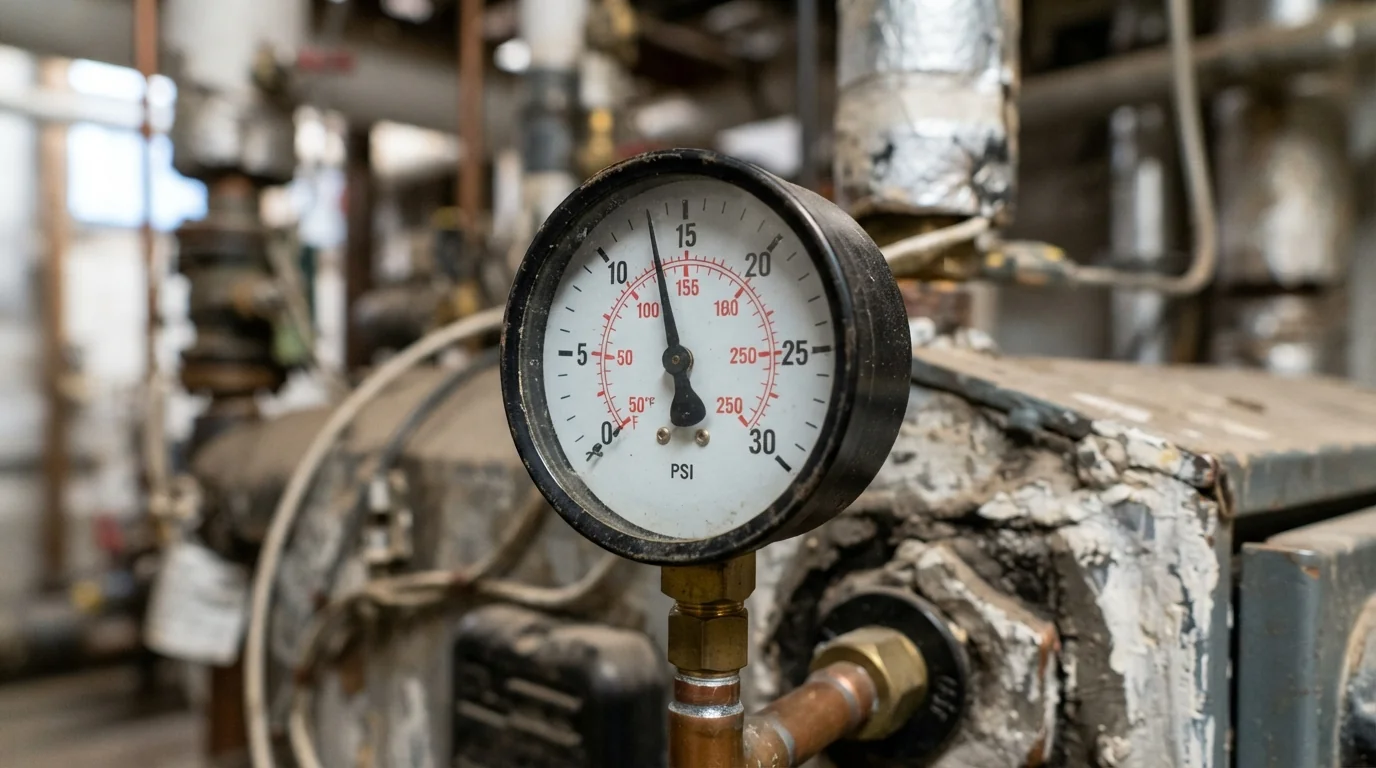
Hot water boilers have a combined temperature and pressure gauge. Cold, most residential systems sit around 12 to 15 psi; hot, they should stay under about 25. A reading that drops toward zero means water is leaving the system somewhere, through a leak, a weeping valve or a failing fill valve. A reading that climbs toward 30 when the boiler fires usually means the expansion tank has lost its air charge.
Write down the cold reading at the start of the season and check it now and then. A steady number is a healthy system. A number that moves is worth a call before the relief valve starts discharging.
Drips, puddles and the relief valve
The relief valve is the brass valve on the boiler with a pipe running down toward the floor. It opens at about 30 psi to protect the system. If there is a puddle under that pipe or the pipe is wet, pressure is rising too high, most often because of a waterlogged expansion tank. Replacing the relief valve alone just hides the cause.
Other drips are worth tracing too: a circulator pump flange, a radiator valve stem, or a zone valve. Small leaks lower pressure over time and let air in, which leads to the next problem on this list.
Cold radiators and noisy pipes
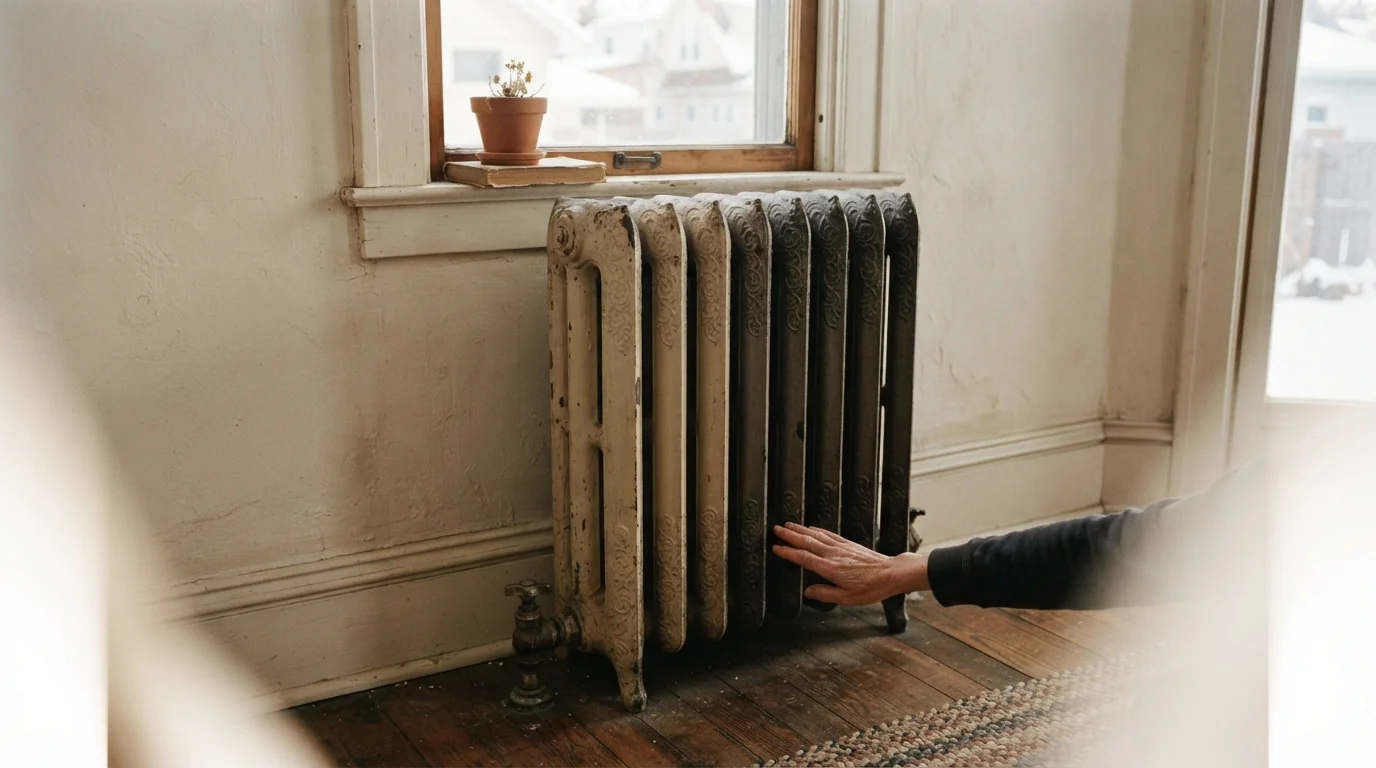
On a hot water system, a radiator that is warm at the bottom and cold at the top has air trapped in it. Bleeding it with a radiator key fixes it, but air that keeps coming back means water is getting in and out somewhere. Radiators cold on a whole floor point to a circulator that is weak or not running.
On a steam system, banging in the pipes usually means condensate is trapped in a pipe that has lost its pitch, and cold radiators usually mean a stuck air vent that will not let steam in. Both are fixable, and both get worse with time. Hissing vents that spit water need replacing.
The sight glass on a steam boiler
Steam boilers have a glass tube on the side that shows the water level. Before the season starts, the water should sit about halfway. A glass that is empty means the low-water cutoff should be shutting the burner off; a level that bounces violently when the boiler runs can mean dirty water or a piping problem. Cloudy, rusty water in the glass means the boiler needs flushing.
Do not add water to a hot steam boiler with an empty glass. That can crack the cast iron. Let it cool and call, or ask a technician to show you how your system's fill works so you can do it safely next time.
When a warning sign means replacement
Most of the signs above are repairs: an expansion tank, a relief valve, a circulator, a set of steam vents. Boilers are built to be repaired, and a sound one can run for decades. The sign that usually ends a boiler's life is a leak from the heat exchanger itself, which shows up as water under the boiler that does not trace to any valve or fitting, or rust streaks down the sections.
If that is what we find, we show it to you and price the replacement, sized to the radiators and the house rather than the old nameplate. Angi's 2026 Minneapolis data puts boiler replacement at $3,201 to $13,171, averaging about $7,896, and our boiler replacement page explains what drives that range.
Flame, smell and soot
A pilot or burner that keeps going out, yellow and lazy flames instead of blue ones, soot around the burner door, or an exhaust smell near the boiler are all combustion problems. They can mean a dirty burner, a failing thermocouple or a venting problem, and they are the ones that can produce carbon monoxide. Make sure a working CO alarm is near the boiler and near bedrooms, and have combustion checked on a service visit.
Questions we get on the phone
Questions readers ask
Around 12 to 15 psi cold on most homes, and under about 25 psi when hot.
Usually pressure is too high because the expansion tank has lost its air charge or the fill valve is letting in too much water.
Trapped air on hot water systems, or a stuck vent on steam systems.
It is usually trapped water from poor pipe pitch. Not immediately dangerous, but it should be corrected.
Typically 20 to 30 years with regular service.
Early fall, before the heating season starts.